Fishing HubALEXFISHER
NATURAL BAIT · MENA

Match your hook to your bait.

Pick your bait, bait size and target fish. Get a hook pattern, size guide and hook-set tips for your next session.

Build your bait rig

Change any choice to update your result.

1What are you baiting up with?
2What size is your bait?
3What is your target fish?
Rig options: hook-set & attachment
How do you set the hook?
How do you want to tie the hook?
SUGGESTED HOOK

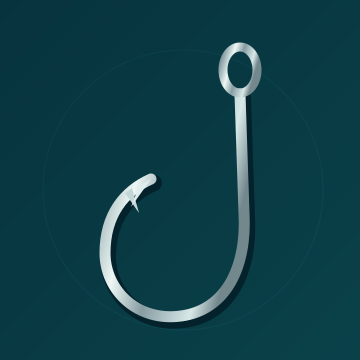
Chinu / bream hook · eyed

Shrimp / prawn · Medium · Any fish / not sure

Chinu / bream hook · eyed
Eyed / ringed · Picture shows the shape, not the size

The wide bend gives shrimp or shellfish room on a short hook.

Sizes to try
#4–2/0

These sizes are a guide only. Leave room between the bait and the hook point. Sizes differ by brand, especially circle hooks.

Hook wire
Thin or medium wire that is strong enough for your fish.
Hook-set
Reel down to take up slack, then make a firm hook-set. Do not wait for the fish to swallow the bait.
Another hook you can tryCircle hook

Do not strike. Let the fish load the rod, then reel steadily to hook up.

LOOK. COMPARE. RECOGNISE.

Hook pictures & uses

Natural-bait hooks for fishing in the Middle East and North Africa: the Mediterranean, Red Sea, Gulf, rivers and lakes. Names can differ by country; use the picture to recognise the shape.

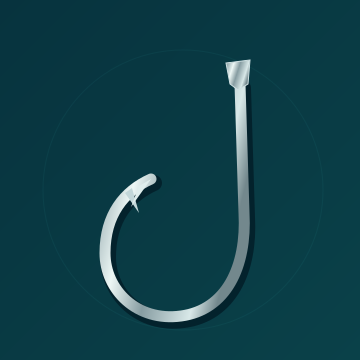
Chinu / bream hook · spade-end
Example shape · not actual size
Spade-end / no eye

Chinu / bream hook · spade-end

A flat head instead of a hole for the line, with a wide bend.

Use it for
Shrimp and shellfish on a snelled hook, with the leader tied around the shank.
Rigging tip
Use a spade-end snell around the shank, or a ready-tied hooklength. Check the knot cannot slip over the flat head.
Hook-set
Reel down to take up slack, then make a firm hook-set. Do not wait for the fish to swallow the bait.

Three simple tips

Angler terms, made simple

Names vary between countries and tackle shops. These short explanations help you follow the guide.

Bait rig
The hook, leader and other parts used to present your bait.
Hook-set
The action that makes the hook point grip. Open-point hooks usually need a strike; circle hooks need steady reeling instead.
Leader
The length of line between your main line and the hook.
Drag
The reel setting that lets line out under pressure. Match it to your tackle strength.
Shank & gape
The shank is the straight part. The gape is the space between the shank and the point; keep it clear of bait.
Snell / spade-end knot
A knot wrapped around the hook shank. Use a knot suited to your hook, or buy a ready-tied hooklength.
Reel down / reel into the bite
Reel down means take up slack before setting a J-hook. With a circle hook, let the fish tighten the line and reel steadily without a strike.
01

Choose the size to fit your bait

Do not cover the point or fill the opening with bait. The same size number can mean different sizes in different brands.

#10 → #4 → #1 → 1/0 → 4/0 → 8/0

Smaller → larger. Shape and wire still matter.
02

With a hole, or without?

An eyed hook has a hole for the line. A spade-end hook has a flat head with no hole: tie the line around its straight shaft. Each type needs the right knot.

Not sure how to tie a flat-head hook? Buy one already tied to line.
03

Circle hook: reel into the bite

A circle hook with no sideways bend can reduce deep hooking. Keep the opening clear. Let the rod load; no hard strike without jerking the rod.

Hooks without a barb (the small backward spike) can be easier to remove.
About this guide & sources

This guide covers common natural-bait hooks, not every model. It does not cover hooks for artificial lures or jigs. The sources explain hook designs and fish care; local fishing rules and brand sizes may differ.

Mustad — Chinu spade-end patternGamakatsu — non-offset circle designNOAA — catch-and-release handling
Preparing your membership…